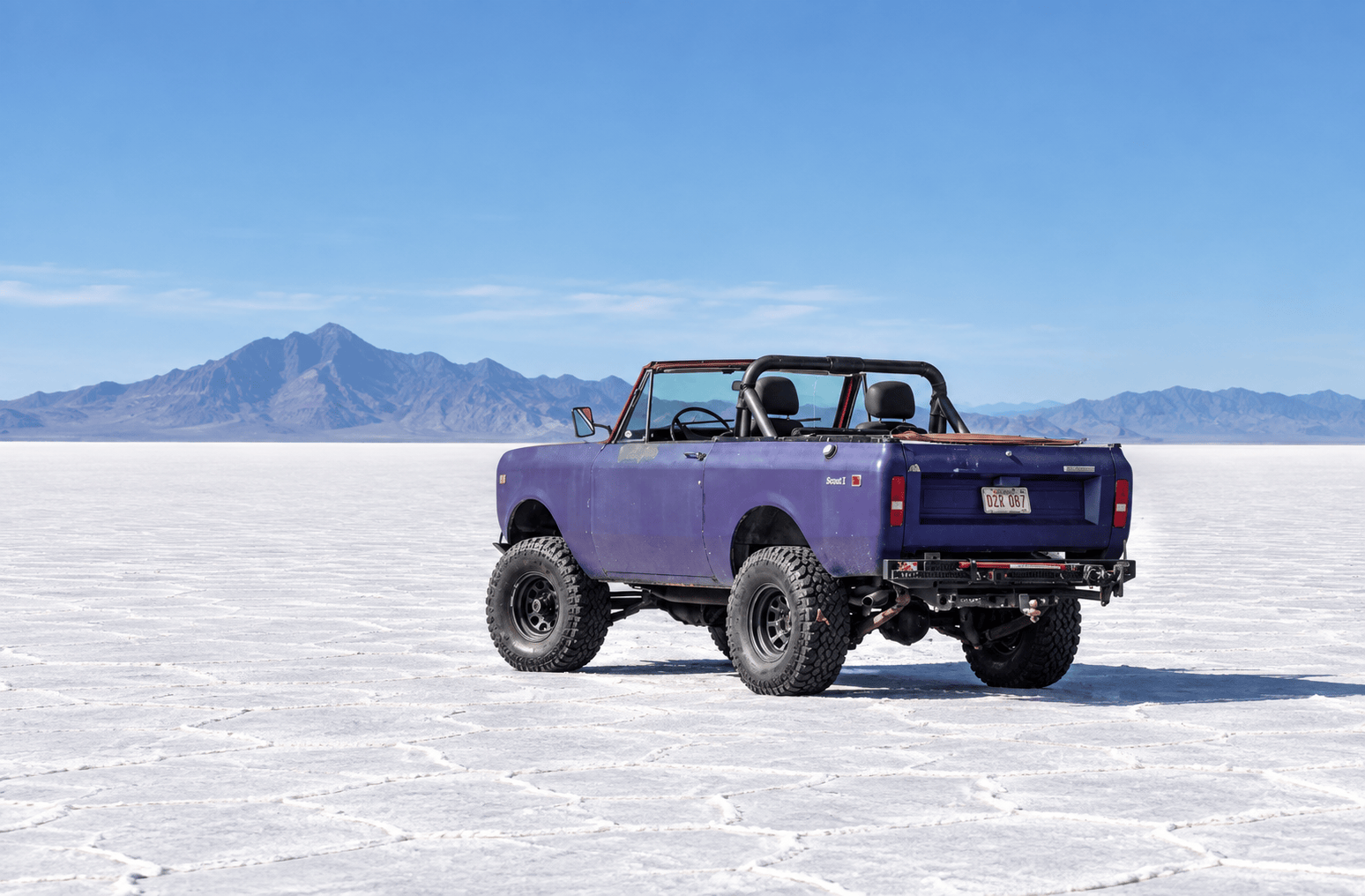

There’s a ton to write about but I haven’t had the time yet. While you wait, here’s a cool picture:

My father-in-law said he knew Duke Cunningham and said he was a self-centered prick. Fuck that guy. Great photo, though.
(via)

Sunday morning update: the Danscout is out of the backyard and safely tucked in the garage! I spent the bulk of yesterday replacing the wheel cylinders, soft lines, and cleaning out the roached pads and drums, capping off the rear brakes, and bleeding the system. I had to spend more time than I wanted futzing with one of the brake cylinders for a while. The threads hadn’t been cut deep enough to make a solid connection with the flare, so I had to double-flare it to make it thicker, and that finally worked. After capping off the rears, I had my daughter help me bleed it out enough to engage the fronts, which was all I needed to move it around the house without fear of driving through the neighbors’ fence. (That drunk fence in the background of my pictures is theirs, but whoever installed it only poured the footers about 4″ deep, so they’ve heaved over the years and come out. I’ve straightened it twice with the Scout and some chains but finally gave up.)
Then I mixed up some antifreeze and topped off the radiator, glad to see it held liquid and didn’t pee out all over everything. After moving all of my tools out of the way, I fired it up and eased it into gear. I think the clutch is pretty well roached, because it only engages at the very end of the pedal throw, but it does engage. I got it around the house, down onto the driveway, and backed it down to the front of the garage for a quick pressure-wash. Most of the dirt, mold, and at least 1/4 of the paint came off pretty easily. I still can’t tell what color this thing was originally, but I believe it was Light Yellow, and then someone hand-brushed another similar coat of yellow over that. The pressure wash blew a lot of the yellow off to reveal gray primer (or perhaps Aspen Green Metallic?) underneath.

With the dirt on the outside cleaned off, I let it dry out and then backed it into the garage. The plan now is to store Peer Pressure in my friend Brian’s spare garage bay for a while as I get the 800 sorted, and swap the Travelall in and out of there to keep both trucks lubricated and running. I’m going to rob the battery from PP to run the 800 for now with the intention of working on it while spending as little as possible.
Before closing up for the night I cut some scrap 14 ga. steel down and made a fuel pump blockoff plate after noticing I’d puked a bunch of oil out of the open hole. This coming week I’m going to drain the remaining oil out and send some away to Blackstone for analysis—I’m curious to see what they can tell me about the health of this engine. I will say that it’s strong and happy to idle, in spite of the fact that I’ve done absolutely no adjustments to the carb or distributor since re-stabbing it. One thing that does need adjustment is the amount of fuel pressure; I’ve got it closed down to 2psi through the regulator, but every time I got on the gas it felt like it was draining the bowl and I’d have to wait until it refilled to be able to get the RPMs up again.
One other funny thing I noticed after I’d pressure-washed it was that the license plate light was actually on! None of the other lights seem to be working, but apparently my daughter was fooling with the knobs and left it pulled out when I was bleeding the brakes. I don’t currently have the brake lights hooked up, but that will be a fun exercise to see if anything else comes to life.
So, the next tasks in line are:
Total costs to date:
| Item | Cost |
|---|---|
| 1966 Scout 800 | $500 |
| Lunch for the recovery crew | $85.00 |
| Curved points | $7.00 |
| Battery cable | $33.37 |
| Carb Rebuild kit, fuel pump | $46.30 |
| Spare plugs, wires, used starter, coil, fluids | $0 |
| Soft brake lines, two wheel cylinders | $68.47 |
| Antifreeze concentrate, 2 brass brake line couplers | $31.77 |
| Total | $771.91 |
I was happy to see my humble three-colored Scout in one of the photos from Scout Motors’ recap of the event; strangely there’s a better shot of her in the social media post.
View this post on Instagram
(I’m in the back of the John Glancy slide, between the shiny new prototypes).
We rolled in after a 9-hour drive; I’ll just drop a few photos here right now and preview the recap by saying it was amazing.


The guy who inspired me to build the seat lockbox for Darth just did another video where he swapped in an Ididit steering column to his ’68. His setup was a bit more complicated because his truck is a column shift and he swapped a Crown Vic subframe/GM powertrain, among other things, but he’s a lot more experienced with fabrication than I am.

When MotorTrend was shut down earlier this year, the management offered first dibs on all of the project cars to each of the hosts. David Freiburger bought the International pickup he resurrected on an episode of Roadkill Garage and cleaned it up for resale.
I would love it if he’d kept this and kept working on it; it’s three years older than Darth Haul and has a straight six engine, but otherwise is a dead ringer: IH red, with 4 speed stick and no frills. $5K is a screaming good deal for this truck.
I’ve found a new ASMR mechanic fix-it YouTube channel that does away with a lot of the stuff that annoys me about most of the other channels out there. Like podcasts, the channels I follow are graded by the content, the presentation, and narration. The last one can be a make or break for me: if the narrator is annoying or has a terrible voice, I’m usually out. There’s a ton of content out there that fit into my areas of interest but which I can’t stand due to failures in the categories above.
Simon Fordman hosts a channel where all he does is fix cars. There’s no audio narration, which demands close attention because he puts it in the closed captioning—so if you want to follow along you’ve got to keep a close eye on things. Watching his latest video, he fixes a formerly abandoned AMC Javelin with starting, idling and brake issues, and just by watching I realized there are three things I need to investigate on Darth Haul: the choppy idle could be a fuel issue or it could be that the points are corroded. He does a simple test at idle to figure out which plugs aren’t firing, checks the gap on the points, and adjusts the timing at the distributor to smooth the engine out.
The car cover I’ve been using tends to trap moisture inside when it’s on the truck. I’ve noticed dampness in the engine bay immediately after removing it, and I’ll bet that’s had some effect on the electronics under the hood. So I’ve got a game plan for my next workday:
